
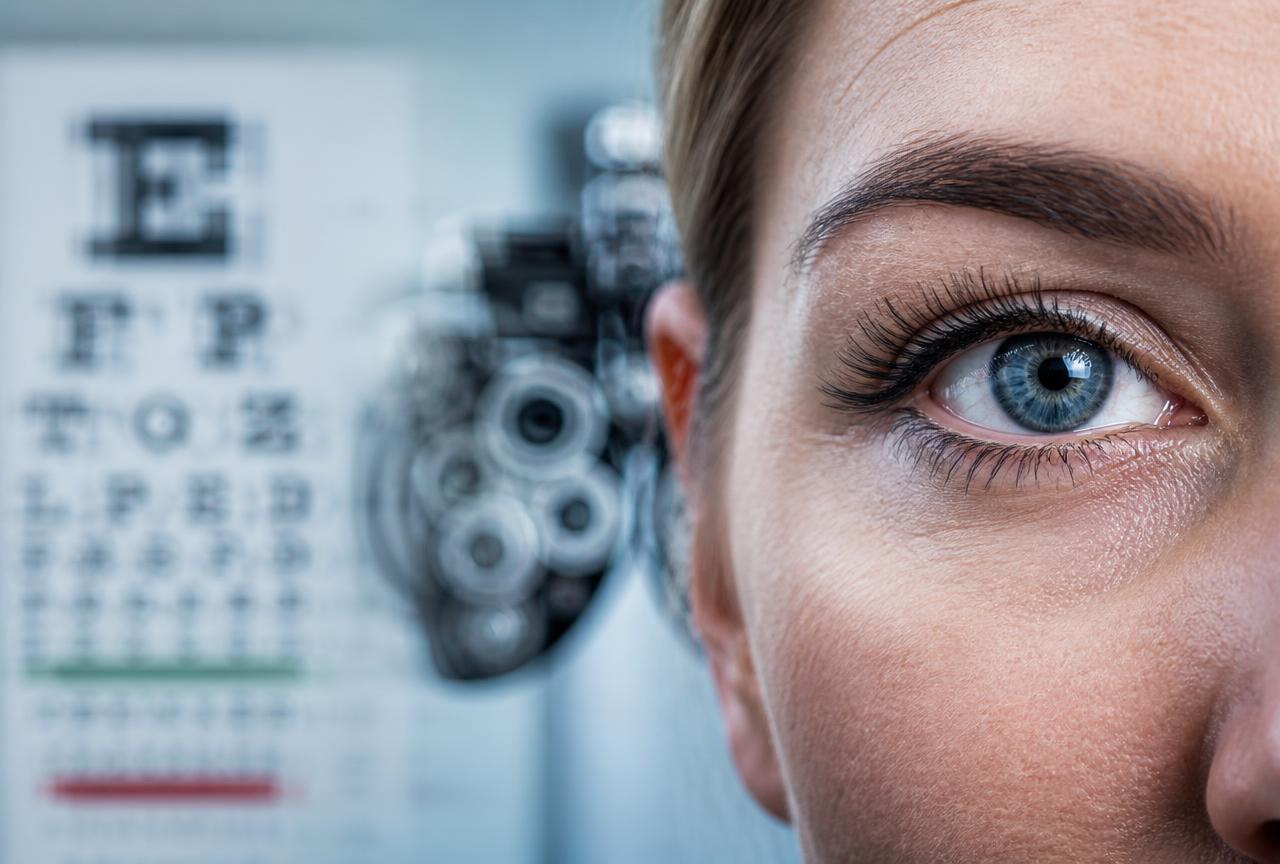
What Is Astigmatism?
Astigmatism is a refractive error in which the rays that pass through the optical system of the eye meet not at one focal point but at two. The result is a blurred image on the retina.
Causes
Astigmatism appears because of an irregular shape or position of the cornea or the lens, or because of damage to them. To see clear, sharp images, a person's cornea and lens must have a regular shape and be healthy and undamaged. With astigmatic changes, the eye refracts the rays differently in the horizontal and the vertical plane. For example, the image may be focused clearly on the retina in the horizontal plane, while in the vertical plane the rays meet in front of it or behind it. This means that people with astigmatism do not see horizontal and vertical elements equally well, so objects around them look stretched vertically or squashed along the horizontal direction, and blurred.
Astigmatism always reduces visual acuity. Accommodation and its long-lasting strain do not always help to see better and very often turn into a spasm. Uncorrected astigmatism is very often the cause of blepharitis and blepharoconjunctivitis. People with astigmatism feel eye fatigue not only after close work, but also after looking intently into the distance for a longer time (a play, a film, driving a car), because without wearing glasses they never see clearly.
Types
There are two types of astigmatism:
- regular — when the refractive power of the eye is greatest in one plane and smallest in the other. This type is the most common and is inherited, congenital. In essence, it is a congenital inherited anomaly that changes little throughout a person's life. Straight, regular, small (up to 0.5 D) astigmatism is very common. People rarely complain about it, and it is also called physiological. Acquired, regular, fairly large astigmatism often appears after intraocular operations (especially after cataract extraction).
- irregular — when the refractive power of the eye differs within the same plane. It is caused by damage to the cornea (scars), keratoconus and similar conditions.
Astigmatism is also divided into:
- simple — when refraction is normal in one plane (emmetropia);
- compound — when the strength of refraction is the same in both planes;
- mixed — when long-sightedness is found in one plane and short-sightedness in the other.
Symptoms
With small astigmatism — up to 0.25 — there are usually no signs at all. However, in the case of stronger astigmatism the symptoms are quite obvious:
- blurred vision,
- a constant urge to squint,
- asthenopia, in other words eye fatigue,
- severe headaches.
Some studies show that there is a link between astigmatism and migraine headaches. It has also been noticed that with short-sightedness or long-sightedness the probability of astigmatism is higher. So if these signs appear, they should not be waved away and blamed entirely on stress or fatigue.
To Have Flawless Vision
The eyes, like other organs, must be taken care of. Everyone, regardless of the condition of their eyes, should visit an ophthalmologist at least once a year and have thorough vision and eye examinations. Examinations are especially important if a refractive error has already been diagnosed — remember that with short-sightedness or long-sightedness the probability of astigmatism is higher. It is also very important to check children's vision in time. A child should first visit an ophthalmologist before the age of one, and later at three and at six. If there are people with refractive errors in your family, children's eyes should be checked more often.
During general eye and vision examinations the doctor can already notice signs of astigmatism. In that case special examinations are carried out: keratometry (the refractive power of the cornea), corneal topography, autorefractometry, retinoscopy and others. After examining the eyes, the doctor records the degree and the axis of astigmatism in the patient's chart (or in the prescription for glasses/lenses).
Astigmatism is a fairly common eye defect — about 30% of the population has astigmatism greater than 0.5 D. Minimal astigmatism — up to 0.5 cylindrical dioptres — has no great influence on vision. Vision is still considered good if the deviation from the norm is no more than 0.0 – ± 0.2 D. However, in some people the irregular shape or position of the cornea or the lens, or damage to them, is clearly pronounced, so the images they see are not only blurred but sometimes even doubled. This happens with astigmatism greater than 0.5 cylindrical dioptres. Some specialists recommend wearing special glasses or lenses for the correction of astigmatism already at 0.25 cylindrical dioptres, but when astigmatism exceeds 0.5 D, vision must be corrected with special cylindrical glasses or toric contact lenses. Nevertheless, glasses and contact lenses are only temporary help and do not remove the refractive error or its causes. Astigmatism can be removed with surgery, and sometimes that is the only possibility to regain flawless vision. One of the most advanced methods is corrective surgery with an excimer laser. During it the shape of the cornea is changed, or a special toric intraocular lens is implanted. However, the treatment method is determined by the type of astigmatism and the condition of the eye and of general health.
Which treatment method is the most suitable in your case will be determined by an eye care specialist. Do not forget to visit the ophthalmologist's office once a year — this way you will avoid eye diseases and their complications.
Keywords: